
She added that the government has extended the PM Garib Kalyan Anna Yojana for five years which is benefiting 80 crore people of the country.

Hospitality and travel sector players on Tuesday demanded infrastructure status for the hotel industry besides measures such as tax exemption on LTA annually to boost domestic tourism ahead of the Union Budget. They also recommended removal of the current TDS levied on automated bookings for internal or closed user groups such as business travel platforms and reducing the total number of licenses required to establish a hotel. "A full-blown infrastructure status for the hotel sector and further rationalisation of the Goods and Services Tax (GST) and a Central single window clearance for hotel projects are some of the major expectations from the Budget 2024," Roseate Hotels & Resorts CEO Kush Kapoor said in a statement.

The time limit is proposed to be extended from the current two years to four years.

So how do you rate the Modi government's 10th budget which comes ahead of the crucial five-state election?
Evidently, households see a brighter future after the Budget, reveals Mahesh Vyas.

The government will launch a Rs 2-crore term loan for 5 lakh first-time women, SC and ST entrepreneurs, Finance Minister Nirmala Sitharaman said on Saturday.

Breaking the nearly three-decade-old dominance of the undivided Shiv Sena, the Bharatiya Janata Party on Friday emerged victorious in the Brihanmumbai Municipal Corporation (BMC) elections, and also vanquished the alliance of Nationalist Congress Party factions led by Sharad Pawar and Ajit Pawar in the Pune civic body.

With Nirmala Sitharaman's Budget presentation lasting for about one hour 31 minutes on Tuesday, the finance minister's budget speech this year became the shortest ever since 2019.

As part of the ritual, ''halwa'' is prepared in a big ''kadhai'' (large frying pot) and served to the entire staff involved in the Budget making exercise of the ministry. Halwa was served while maintaining COVID protocol with all present in mask and those distributing sweets were wearing gloves.

Finance Minister Nirmala Sitharaman's Budget proposals lay out a comprehensive road map for transforming India into a developed nation, focusing on key priorities that aim to generate ample opportunities for all citizens in "Viksit Bharat". It sets the stage for sustained economic growth, social development, and technological advancement.

The Comptroller and Auditor General of India (CAG) has launched an integrated audit across 32 states and Union Territories to assess the ease of doing business for the micro, small and medium enterprise (MSME) sector.

Gold, silver and other precious metals along with imported mobile phones, certain cancer drugs and medical devices are set to become cheaper with Finance Minister Nirmala Sitharaman announcing cuts in customs duty in the Union Budget 2024-25.

The old tax regime remains unchanged. 'Taxpayers opting for it will continue to follow the existing slab rates and deductions.'

President Droupadi Murmu has given her assent to the Viksit Bharat Guarantee for Rozgar and Ajeevika Mission (Gramin) Bill, which aims to replace MGNREGA and guarantee 125 days of wage employment per rural household.

This has been our history of good governance: Things that were difficult to do and required planning and implementation were first taken up and then abandoned, notes Aaakr Patel.

I am inclined to believe that the Venezuela adventure is not an indication of American strength, alas, but rather of American weakness, points out Rajeev Srinivasan.
Finance Minister Nirmala Sitharaman will present the Union Budget for 2023-24 in Parliament on February 1. The Budget is a statement of the government's estimated receipts and expenditures for a fiscal year (April 1 to March 31). It's divided into Revenue and Capital Budget. The Revenue Budget includes the government's revenue receipts and expenditures while the Capital Budget includes its capital receipts and payments.

CAG warns most states of fiscal imprudence as March spending overshoots limits, with key departments exhausting large portions of budgets in the last month of FY24.

7 key areas that the Budget must address to re-energise the infrastructure sector, suggests Vinayak Chatterjee.

The data for individual weighted received premium (WRP) showed divergent trends for life insurers in December 2024. Overall, the industry's individual WRP grew 4.8 per cent year-on-year (Y-o-Y); LIC's individual WRP declined 13 per cent while private players saw 11.4 per cent growth.

For every rupee in the government coffer, 58 paise will come from direct and indirect taxes, 34 paise from borrowings and other liabilities, six paise from non-tax revenue like disinvestment and two paise from non-debt capital receipts, according to the Budget documents for 2023-24.

While the minimum holding period for LTCG taxation has now been lowered, the tax outgo could be a bit higher under the new structure.

The government on Tuesday announced a new centrally-sponsored scheme for skilling 20 lakh youth over the next five years. The announcement was made by Finance Minister Nirmala Sitharaman in the Union Budget 2024-25. The minister said that model skilling loan scheme will be revised to facilitate loans up to Rs 7.5 lakh.

Whether she will pare the fiscal deficit target of 5.1 per cent of GDP, using the record dividend received from the RBI, or expand flagship government programmes will be keenly watched.

The ruling Bharatiya Janata Party on Wednesday hailed the Union Budget as an "all-inclusive" document while the Opposition dismissed it as "anti-people" and mere rhetoric lacking the vision for creating jobs and taming inflation.

Glimpses of lady MPs as the nation's lady finance minister presents the Budget for the next financial year on Wednesday, February 1, 2023.
The government on Tuesday announced that it will undertake a comprehensive review of the Income Tax Act to make it easy to read. Presenting the Union Budget for 2024-25, Finance Minister Nirmala Sitharaman also said the government will come out with SoP (standard operating procedure) for TDS defaults and simplify and rationalise compounding of such offences.
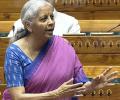
The Lok Sabha on Tuesday passed the Finance Bill 2025, along with 35 government amendments, including one that abolishes a 6 per cent digital tax on online advertisements.

Party leader Rahul Gandhi dubbed the Union Budget as a 'zero-sum budget', saying it has nothing for the salaried, middle class and the poor.

Recognising job creation for the youth as the foremost challenge for the economy, Finance Minister Nirmala Sitharaman on Tuesday announced a comprehensive Prime Minister's package to facilitate the employment and skilling of 41 million youth with a central outlay of Rs 2 trillion over the next five-year period. The package will consist of five schemes and initiatives - three focused on jobs and two on skilling.

In a major relief for taxpayers, Finance Minister Nirmala Sitharaman on Saturday announced an increase in the threshold for Tax Deduction at Source (TDS) on rent from Rs2.40 lakh per annum to Rs6 lakh per annum while presenting the Union Budget 2025-26. Presenting the budget in Lok Sabha, the Finance Minister said, "The annual limit of Rs 2.40 lakh for TDS on rent is being increased to Rs 6 lakh.

India's gems & jewellery exports witnessed 30.6 per cent year-on-year (Y-o-Y) contraction in October to $2.17 million, amid the imposition of a steep 50 per cent tariff by the United States (US) on several Indian products.

"There has been a 0.05 percentage points decline in the share of allocation for child budget to the Union Budget from 2.35 per cent (2022-23 BE) to 2.30 per cent (2023-24 BE).
Two men were arrested and a minor boy was detained on Monday in connection with the harassment of Union Minister Raksha Khadse's daughter and her friends. The incident took place at a religious event in Maharashtra's Jalgaon district on February 28. The accused were charged with stalking, sexual offenses, and taking photos and videos of the girls without permission. The incident has sparked outrage and calls for swift action against the perpetrators.

General Budget is a terminology earlier used to differentiate between the Union Budget with the Railway Budget. Full-fledged budgets are titled "Union Budget", while interim Budgets are titled just that.
India has allocated Rs 1.72 trillion, or 27.67 per cent of the total defence budget to cater to modernisation of the country's arsenal. Modern militaries spend up to 50 to 60 per cent of their total defence budget so that they go into combat with superior weaponry and equipment.

Here's how the budget impacts the pocket of the common man.

Finance Minister Nirmala Sitharaman on Wednesday again took a digital tablet wrapped in a traditional 'bahi-khata' style pouch as she headed for Parliament to present Union Budget 2023-24 in a paperless format just like the previous two years. She posed for the traditional 'briefcase' picture outside her office along with her team of officials before heading to meet the President. She, however, was holding a tablet instead of a briefcase to present the Budget in a digital format.

While this will incur a revenue loss amounting to 0.2 per cent of GDP, it will provide a strong boost to consumer sentiment and spending, points out Rajani Sinha.

Congress leader Priyanka Gandhi Vadra criticizes the government's proposed bill to replace MGNREGA, arguing it weakens the guaranteed 100 days of employment for the poor and centralizes control over the scheme.
